
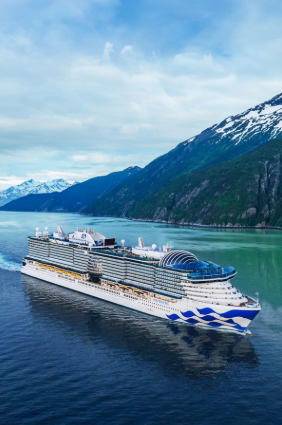
Cruises: Movement Without Urgency
There’s something quietly disorienting about moving every day without feeling the need to go anywhere.
On a cruise, the horizon changes constantly, yet your body never prepares for motion in the way it does on land. You unpack once. You stop calculating distances. You stop checking the clock with purpose. Time loosens its grip and begins to feel less like a resource to manage and more like something to inhabit. Days are shaped not by miles traveled, but by light on the water, by weather rolling in, by appetite, by the slow unfolding of conversation.
The ship keeps moving whether you acknowledge it or not. That steady, indifferent forward motion does something subtle to your nervous system. You’re progressing without effort. Advancing without decision. For people accustomed to planning every step, that alone can feel like relief—or, at first, like a loss of control.
What surprised me most wasn’t the destinations themselves. It was the permission to pause while still making progress. To wake up knowing you’ll arrive somewhere new without orchestrating the arrival. No rental counters. No highway signs. No packing and unpacking rituals that fracture the day. The machinery of travel disappears behind the scenes, and what’s left is a rare kind of mental space—room to notice smaller things that usually get overlooked.
Morning coffee tastes different when the sea is calm. Silence feels heavier, more intentional. Conversations linger because no one has anywhere else to be. Even boredom has texture—it isn’t something to escape immediately, but something you sit with until it turns into reflection. You start listening more carefully, both to others and to yourself, because nothing is rushing you forward.
But there’s a tension beneath all of this ease.
That same structure that creates freedom can also create distance. You are carried, not embedded. You arrive at places without fully entering them. Ports are generous but brief, carefully timed, and subtly transactional. You’re always aware—if only faintly—that the world you’re touching belongs more to the schedule than to you. There’s beauty in that efficiency, but also a quiet loss. Depth is sacrificed for continuity. Presence is negotiated.
Cruises can dull the edges of experience if you’re not careful. Comfort is abundant. Effort is optional. And without effort, some moments don’t anchor themselves as deeply. It’s easy to float through days pleasantly without fully engaging, mistaking relaxation for connection. The ship asks very little of you, and sometimes meaning requires more than that.
Still, the value of cruising isn’t escape in the dramatic sense. It’s relief—from constant choice, from urgency disguised as importance, from the pressure to optimize every hour. It’s a reminder that movement doesn’t always have to be earned through exhaustion, and that progress doesn’t always require struggle.
Cruises teach a quieter lesson: that there is a version of travel where you stop steering for a while. Where you allow yourself to be carried. Where you let the world come to you instead of chasing it.
And sometimes, especially after years of motion driven by obligation, that surrender is not indulgence—it’s necessary.